ABOUT OUR COURSES OUR COURSES HOME
Our online courses at Deway School are structured to support diverse learning styles, offering a self-paced format with the backing of dedicated teachers to facilitate student learning. You can access our courses easily, 24 hours a day, 7 days a week.
ENROLL ANY TIME
There's no need to wait for a new semester to begin your course. Enrollment at Deway School is open year-round, allowing you to start learning at any time that suits you.
RIGOROUS CURRICULUM
Deway School provides a robust curriculum, with courses approved by the University of California. These courses enhance a student's prospects for admission into universities and colleges and are widely recognized across the United States. Known as A-G Courses, they are a series of high school classes required for admission to the California State University and University of California systems. Most private and other public universities and colleges across California and the United States also accept these courses. The aim of the A-G curriculum is to ensure students gain essential core subject knowledge, preparing them effectively for college.
Our online curriculum includes both core and elective courses, offering opportunities for students to explore their personal and professional interests. All courses are academically rigorous and aligned with state and national standards. Additionally, we offer a comprehensive range of online Honors and AP courses for students seeking to challenge themselves academically and better prepare for college.
PACING AND ATTENDANCE REQUIREMENT
The Deway School curriculum allows students flexibility in the amount of time spent on schoolwork. The Deway School views student success in terms of lesson mastery, not attendance hours; however, we have found that online learning mastery requires consistent and substantial attendance. Classes are designed to be one semester in length, which is equal to 18 weeks. Students are able to complete classes anytime within the 18 weeks. Summer School classes are 8 weeks in duration. Class content is not condensed; instead time expectations per day are increased to accommodate the condensed timeframe. The following chart represents typical attendance hours required to achieve lesson mastery in a full, six-course load:
| GRADE LEVEL | YEARLY HOURS | SUGGESTED WEEKLY HOURS | SUGGESTED DAILY HOURS |
| GRADES K-2 | 720 | 20 | 4 |
| GRADES 3-5 | 900 | 25td> | 5 |
| GRADES 6-2 | 900-1080 | 25-30 | 5-6* |
ONLINE COURSE STRUCTURE
All of our classes share a similar structure to promote familiarity and ease of use of our platform. Each course is designed to include the following features:
TUTORIALS: Tutorials provide direct instruction and practice interactions. Instruction is made engagingthrough the use of videos, animations, interactive timelines, and graphics. Practice interactions—including drag-and-drops, ordered problem solvers, multiple-choice questions, and fill-in-the blank questions—all help students check their progress on mastering new concepts.
LESSON ACTIVITIES: These written assignments allow students to apply learning from the tutorial in a significant way. Lesson Activities are designed to be an authentic learning and assessment tool: doing something real to develop new understanding, while at the same time providing a subjective measure of that understanding.
ONLINE DISCUSSIONS: An online threaded discussion mirrors the educational experience of a classroom discussion. Teachers can initiate a discussion by asking a complex, open-ended question. Students can respond to the question as well as to the responses of other students.
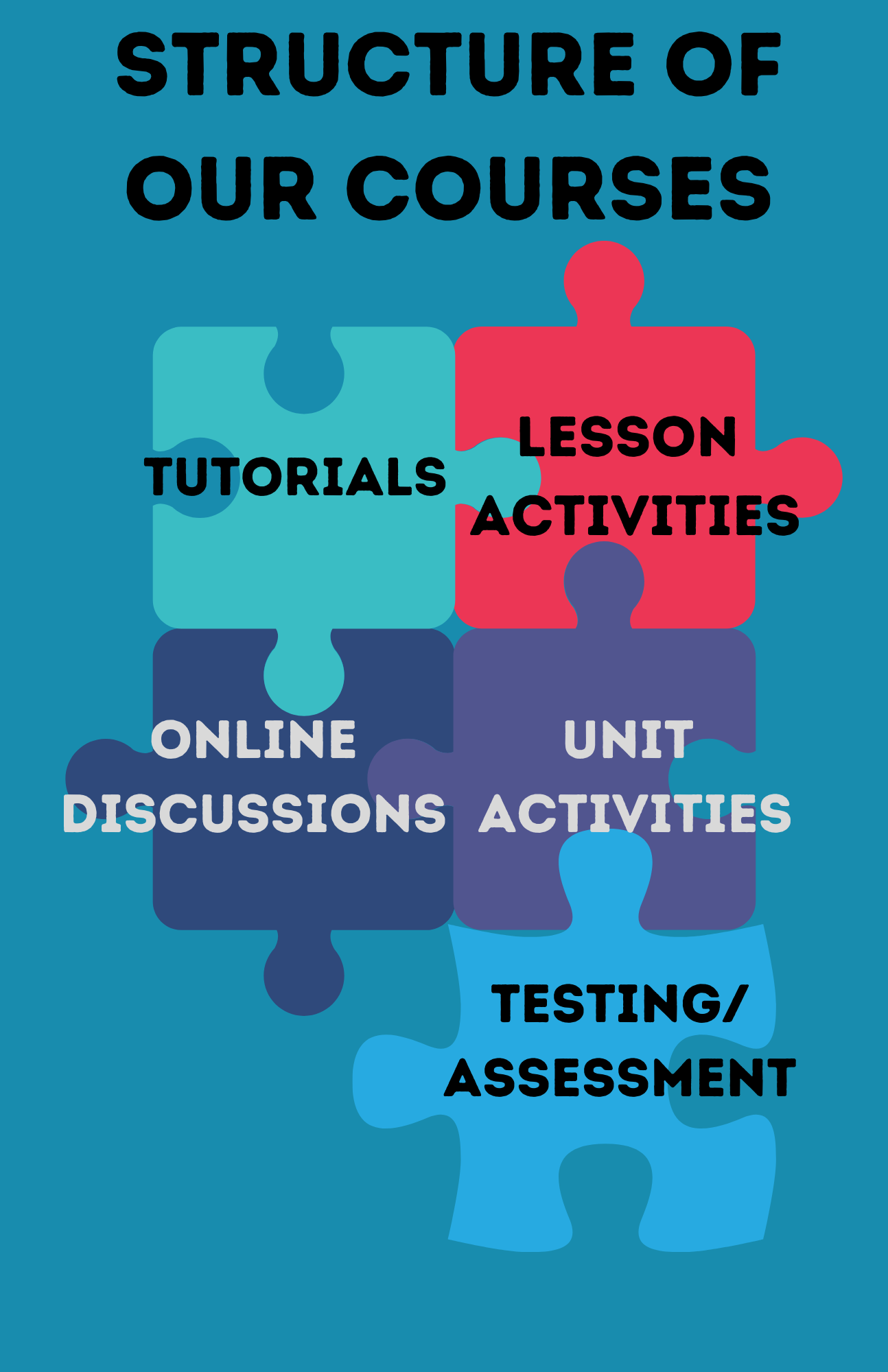
UNIT ACTIVITIES: The culminating activity at the end of each unit aims to deepen understanding of some key unit objectives and tie them together, or tie them to other class concepts. Unit activities supply a document for offline use by students to write a response or record results.
TESTING & ASSESSMENT: Best practices in assessment and testing call for a variety of activities to evaluate student learning. A mastery test at the end of each module or lesson provides the teacher and the student with clear indicators of areas of strength and weakness. These multiple-choice tests are taken online. A unit posttest helps a teacher track how well students have mastered a unit’s content. An end-of-semester test assesses the major objectives covered in a class. By combining the unit posttest information with the end-of-semester test results, teachers will get a picture of student progress.